Showing posts with label reading. Show all posts

We Taught Our Four Year Old How to Read. Here's How.

Monday, March 3, 2025


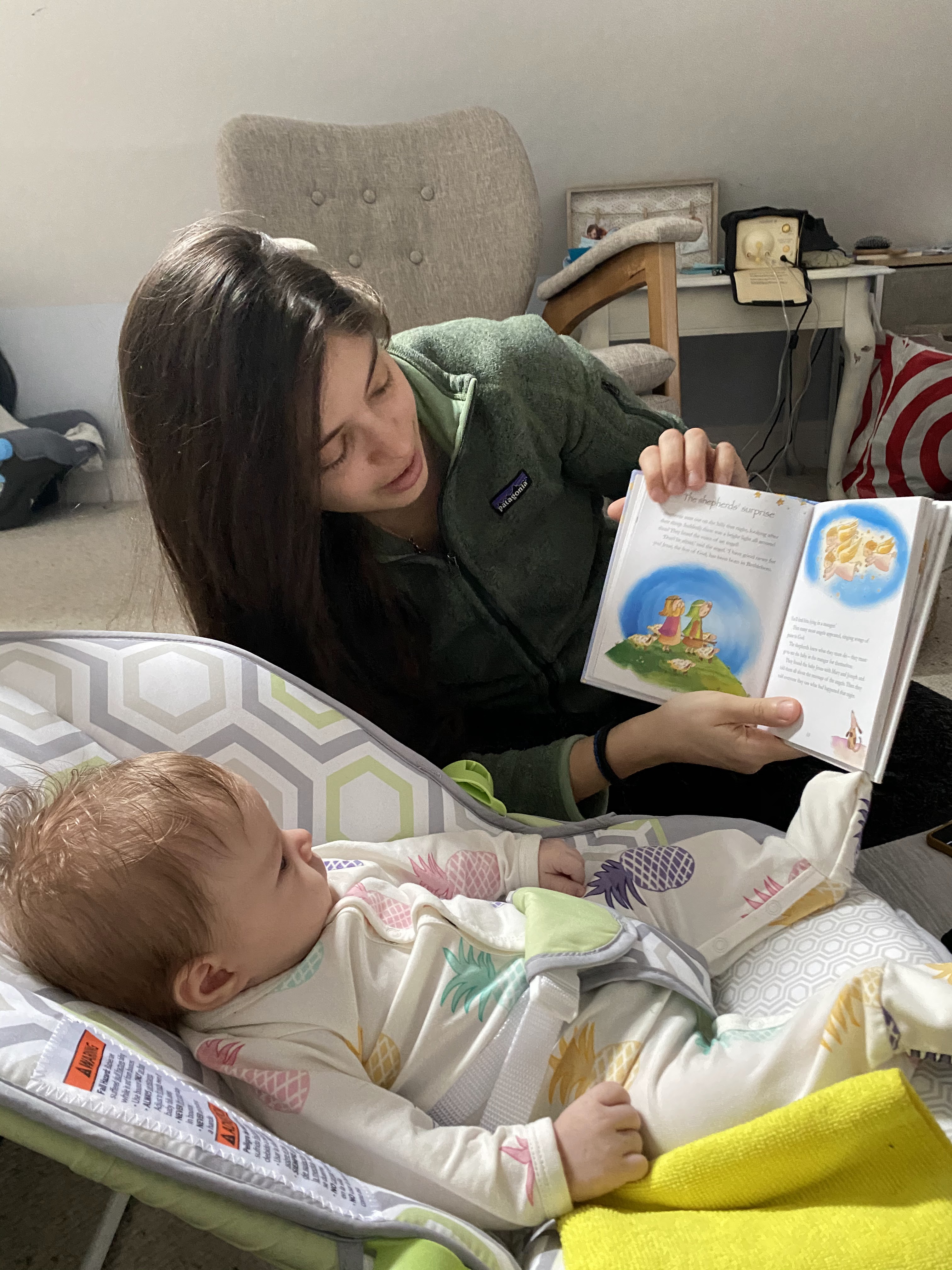
As a writer and lifelong bookworm, raising another book lover was high on our priorities from well before birth. I mean, we read to E basically from pregnancy onward! I wrote about some of our intentional pre-reading habits here, if you're interested- find that here

But this is a post about reading. It took us a long time to get here, but as of February of this year, our four year old is reading basic books and on a clear, steady path to becoming the latest family bookworm. How we got here was not a smooth ride- we tried lots of strategies, books, lessons, and games with varying degrees of success. Here's the step by step of how we got started on the journey, the twists and turns and when and how things finally clicked! Plus a lot of our favorite resources at the bottom.

Phase 1: exposure. This is well documented in my last post so I will keep this short. Basically from when she was still in my belly, P and I read to E. Then when she arrived, we read some more. As she grew, we KEPT READING. We are read at least a few minutes here and there every day and are on a first name basis with our local librarians. There's good evidence to show language exposure through reading is an important part of raising readers.* 

Phase 2: lessons at 3 (tried and failed) when E was just under 3, she started school. Not long after she started, E started coming home telling us letter sounds, so from pretty early on she was exposed to phonics. After her first semester as we approached spring break, I was trying to figure out a schedule for her days off. One of the things I was considering doing with her was phonics during M's morning naps. We discovered the Teach Your Child to Read in 100 Easy Lessons, and armed with that, some advice with my early childhood educator mom, and some Bob books, we jumped right in. 

The first 10 lessons, which are pre-reading skills, went great. But things quickly went downhill. E was not engaged and very resistant to lessons. I wanted things to be child-led, and it was clear where E was leading things. She was not enjoying it and did not want to do the lessons. So, as stubborn as I can be, the humbling experience of parenting prevailed and we took a break from reading lessons. It was hard for me to do, but clearly the right move for E. 

Phase 3: backing off. From March of last year up until December, we did zero formal reading lessons. None. I did try once or twice again over the summer to approach the idea again, associating lessons with rewards and trying the first Bob book, but she made it clear she wasn't interested. 

So instead, we focused on other activities that she enjoyed. We read together as always, participated in the library summer reading challenge, and played letter sound games (what can you think of that starts with the eh sound? How about B?). We sang the apple apple A-A-A song. On trips where she had her iPad we played phonics games. We looked for letters we recognized out and about on signs and billboards. I only asked if she wanted to try reading lessons again a handful of times, and she made it clear that she wasn't ready. I figured we could try again over spring break if I felt she was ready. 

Phase 4: When E returned to school from winter break, she was sent home with the first Bob book, a list of sight words, and a reading log. From here we let her decide if she wanted to do the log (after all, she is not even technically in preschool at this point), and most of the time, with a fair bit of help and encouragement, she was able to sound out 3 letter words. 

That was about a month ago, and now she is well on her way in her reading journey. While she doesn't read independently (and we don't push it) she can easily sound out basically structured words and a few sound words. It has been fun seeing how quickly she is learning now that she's really ready, and we're very excited to see where the spring takes us! 

Before I wrap up, here are our favorite resources and strategies that we used to expose her to phonics and help her along on her reading journey, with links included.

Teach Your Child to Read in 100 Easy Lessons. I will start by saying this was my *least* used resource on the list. It really did not work well for our kid. However, I know several parents that have vouched for this method, enough that I am keeping it at least a few more years to use with M. The approach is certainly simple and evidence based. 

Bob books. I think this is a pretty well known one, but worth mentioning. E enjoys them and loves that she can put them in her purse to read at church or on long car rides (she is an accessories girly all the way) 

Teach Your Monster to Read. We had a few trips last spring and while E didn't quite get the hang of this game at first, she did like it and play it with our help. I plan to use this game for her on our next road trip and imagine she'll enjoy it even more now. 

Chapter books. This one surprised me, but I'm convinced that the language exposure made a difference for E. She got a bunch of Angelina Ballerina and Catwings early chapter books for her birthday, whizzed through them over winter break, and started reading phonetically not long after. The combination of words and pictures in a new format really excited her, and it made her feel like a big girl to read such long books. 

Other games and songs. Simple games like "let's take turns thinking of things that start with the letter B", I spy letters on signs,  or the apple apple A-A-A song by Barbara Milne, were a regular occurrence in our house leading up to E's breakthrough. They may seem like small activities but I do think repeatedly using these strategies over a year made a big difference!

That's our story. What strategies are you using to read with your kids? 

A final note - if your kid is not showing signs or interest in learning to read. Please do not sweat it! Most children start reading around 6 or 7 years of age, and there is really no rush to push them to start reading sooner. I was totally ready to wait another year or two, if our school teachers didn't feel my daughter was ready. 

Reading With Your Kids

Thursday, August 8, 2024


 About a year ago I submitted an article to Readingwithyourkids.com. Lately I've been revisiting this area in my own life as we're working hard to raise a fellow book worm, so I'm republishing it with permission here. Hope you enjoy! PS, Rory and the folks at Reading with Your Kids also have a podcast which is a really great listen for my fellow kidlit lovers. 

Before my daughter was born, my husband and I read to her. We'd pick a book from the small pile my mom, a retired school teacher and children's librarian, had sent us in the mail, giggling at the awkwardness of animatedly telling a story to my belly. We'd laugh at lines like, “Daddies are delicious,” and wonder what she'd think of these books once she arrived. 


Those early days feel long behind us now, but we never stopped reading to our daughter, now three, and our son, who just turned four months old. We've all gone through phases of waxing and waning interest and engagement, like our daughter at four weeks of age, when she'd stare at us with a puzzled expression—or just cry—or at one year when the most interesting thing about books was the flavor. From the sleepless nights of early infancy to the trying days of defiant toddlerhood, we have always come back to reading together. Whether cuddled on the couch on a rainy afternoon or plopping down in a corner of our local library, reading together has become a comforting constant for our family. 

Reading as a family is more than just a pleasant activity to enjoy together. Reading to children as young as newborns has many benefits both in their early brain development and further down the road once they are school-aged. Literacy has been associated with higher education completion rates and earning potential and lower school dropout and incarceration rates. Moreover, the vast majority of brain development occurs in the window from birth to two years of age. Reading to children during this critical period facilitates that development. 

The benefits of reading with young children are well studied, and as a pediatrician, I'm lucky to work with and counsel new parents throughout early childhood on why reading to children can be so beneficial. Here are just a few reasons why reading to your kids is so important—especially at a young age—and some tips on making it more fun as a family. 

Reading aloud improves early childhood vocabulary. Children learn words from what they hear in the world around them. Some of this comes from conversations with parents and peers. But books—even picture books—have richer, more complex language and expose children to higher-level vocabulary at an early age. Both types of language are crucial for success later in life, and the more words children are exposed to early in childhood, the more successful they are at reading once they reach school age. 

You certainly don’t have to start with long books containing big words or complex sentences; in fact, it’s best to start small. For young infants, choose picture-forward books with shorter text. Brains are programmed to enjoy looking at faces, so books featuring people and facial expressions are a good choice at this age. You can talk about things happening in the pictures, ask open-ended questions, and point out objects on the pages. 

Reading exposes infants to natural speech patterns. Have you heard of serve and return language? If not, you've certainly heard it. It's the natural way that people converse with each other every day, such as asking a question while another person replies or making a comment that someone responds to. It’s often described as a tennis match. One person serves the ball to their partner across the net, and the other returns it, continuing the conversation This type of interactive speech pattern has many benefits both in speech development and secure attachment to caregivers. Not only does it model and help babies practice this style of speech pattern, but also, by encouraging and responding to an infant’s coos and babbles, it fosters secure attachment and positive brain development. 

How can you practice serve and return language with your kids? Ask questions! What do you think will happen next? Who do you see in this picture? Will you count all the animals with me? Try it the next time you're reading with your child. Even in the pre-verbal period, this encourages infant babbling, which develops into normal language patterns later in life. 

Reading together promotes parental bonding. When you enjoy doing something, you want to do it more. Anyone who has binge-watched a TV show or eaten chocolate can tell you this, but it’s also a scientific fact. Reading is no different. When children associate reading with curling up on the couch with loved ones, it creates a positive association that will bring them back to reading again and again. 

Some great ways to incorporate more reading into quality time include reading during bedtime and naptime routines, taking little ones on outings to the library, and attending local story time events with them. We also always keep books within arm’s reach at home—we keep a large basket of picture books next to the couch, in our bedroom, and in our children’s play spaces. Some parents may use a tent, pillows, or toddler-sized furniture to create a reading nook in the home. This creates plenty of natural opportunities to plop down on the couch and read together. 

Reading the same story allows for language acquisition. Any parent of a toddler right now can probably recite every word of at least one of their kid’s favorite books. For us, it’s Little Blue Truck and Chicka Chicka Boom Boom. At their peak, my daughter would ask us to read these books upwards of ten times a day. What gives? As it turns out, it’s more than just your toddler trying to assert some autonomy (although that’s certainly part of it). Every time you reread that story, your child is listening, learning, and solidifying their understanding of new words and concepts. With each reread, children are listening, processing, and understanding more of what’s being read. 

Reading together is an important part of school readiness. In addition to exposing children to natural speech patterns and vocabulary, reading together introduces children to the building blocks of literacy. This includes identifying sounds in spoken words, connecting letters to sounds, understanding what is being read, vocabulary, and fluency. While your child doesn't have to be reading before kindergarten, exposure to the building blocks of literacy through reading aloud together will help children achieve literacy once they reach school age. 

A final note. Reading to a young child is not always easy. It may feel strange in early infancy or later, in the toddler years. It may become exhausting as they get distracted, uninterested, or feel too wiggly to sit through an entire book. The one constant in early childhood is that kids change constantly; what didn’t appeal to them last week will suddenly become their favorite thing. Remember, if your child goes through a period where they’re no longer interested in reading, don’t push it, and try not to sweat it. You can always switch to shorter books, less time reading, or take a break altogether and try again in a few days.

Not long ago, I came home from a shift stressed out. It had been a busy day, with back-to-back patients, complicated issues to triage, and little time to eat, drink, or pump breast milk for my baby boy. I walked through the door on edge and eager to shower off the stress and germs of a busy day at the clinic before hugging my little ones. 

“Mama, I missed you! Can we read?” My daughter, almost three here, was making a beeline to hug me, scrubs and all. 

“Not yet!” I said. “Wait until I’ve showered!” 

Since we’re heading into cold and flu season, I make a conscious effort to change clothes before embracing my children. A shock of guilt ran through me. The disappointment was written all over her face. 

I hurried through my shower and tossed on my favorite lounge pants, sweatshirt, and socks, eager to find my daughter before she lost interest in hanging out with me. I found her in one of our favorite reading spots, curled deep into the corner of our couch, surrounded by her stuffed animal friends, her favorite plastic Maui figurine, and, of course, piles of picture books. She was reading to herself—or at least trying. She’s memorized a few of her favorite titles by heart. 

“Sorry, I had to shower first,” I told her. “Can we still read some books together?” A smile lit up her face. “Of course we can!” she exclaimed. “Let’s start with this one.” 

Sources: 

1. Lee, Melissa. When it comes to salary, it’s academic. The Washington Post, July 1994. 

2. Rogot et. al. Life Expectancy by Employment Status, Income, and Education in the National Longitude Mortality Study. Public Health Reports July-August 1992 (107): 457-461. 

3. Pfefferbaum A, Mathalon DH, Sullivan EV, Rawles JM, Zipursky RB, Lim KO. A quantitative magnetic-resonance-imaging study of changes in brain morphology from infancy to late adulthood. Arch Neurol. 1994;51:874–887 

4. Massaro DW. Reading Aloud to Children: Benefits and Implications for Acquiring Literacy Before Schooling Begins. Am J Psychol. 2017 Spring;130(1):63-72. doi: 10.5406/amerjpsyc.130.1.0063. PMID: 29508957. 

5. Serve and return. Center on the Developing Child at Harvard University. (2020, January 27). https://developingchild.harvard.edu/science/key-concepts/serve-and-return/ 

6. Kok, R., Thijssen, S., Bakermans-Kranenburg, M. et al. (2015). Normal variation in early parental sensitivity predicts child structural brain development. Journal of the American Academy of Child and Adolescent Psychiatry, 54(10), 824–831.

7. Kuhl, P.K., Ramírez, R.R., Bosseler, A., Lin, J.L. & Imada, T. (2014). Infants’ brain responses to speech suggest analysis by synthesis. Proceedings of the National Academy of Sciences. 111(31) 11238-11245. 

8. Malenka RC, Nestler EJ, Hyman SE (2009). Sydor A, Brown RY (eds.). Molecular Neuropharmacology: A Foundation for Clinical Neuroscience (2nd ed.). New York: McGraw-Hill Medical. pp. 147–148, 367, 376. 

9. Razdan, S. (2023). 10 tips to help your child fall in love with reading. HealthyChildren.org. https://www.healthychildren.org/English/ages-stages/gradeschool/school/Pages/10-Tips-to-Hel p-Your-Child-Fall-in-Love-with-Reading.aspx#:~:text=Read%20together%20before%20bedtime.,r ead%20a%20book%20to%20you! 

10. Horst JS, Parsons KL, Bryan NM. Get the story straight: contextual repetition promotes word learning from storybooks. Front Psychol. 2011 Feb 17;2:17. doi: 10.3389/fpsyg.2011.00017. PMID: 21713179; PMCID: PMC3111254. 

11. burrows, heather. (2017). Reading and literacy in children | CS mott children’s hospital . Reading and Literacy in Children. 

https://www.mottchildren.org/posts/your-child/reading-and-literacy-children

Life Lately

Sunday, September 10, 2023


I don't know why, but I always loved reading the life lately or ten things I'm loving-style posts on old school blogs back in the day. I still read the weekly updates on Cup of Jo and A Beautiful Mess and enjoy them. I wrote a few, but never consistently. I thought it might be nice to do a check in like this once a month.

- I was reading some heavier things earlier in the summer, and while I enjoyed them (Demon Copperhead was so good y'all,) I was definitely ready for something lighter. The Very Secret Society of Irregular Witches is definitely fitting the bill. It's got a very cozy vibe which I love

-  now that Peter is back at work, we're trying to come up with strategies to make weeknight meals a lot easier. One thing we've tried is baking protein and veg on a sheet pan and pairing it with a grain and a sauce. I became pretty obsessed with baked salmon sushi bowls during pregnancy, but we recently got this cookbook from the library to try some new recipes. Would love recommendations if you have any! 

-  since 'rediscovering' some old favorite artists I can't get this album out of my head. Absolutely love it and it brings me back to such a specific time in my life. Here's another favorite older playlist I keep coming back to. And if you have any more recommendations, please share! I'm always looking for new artists to get into! 

-  we had to get E an email for her global entry application, and I realized we could sign her up for Crumbl cookies emails and get her a free cookie for her birthday! Just a PSA for any other cookie monsters out there :) 

-  it's late in the season but we finally got through our first hurricane touchdown here in Florida. As hurricanes become more severe and intense due to climate change, it's so so important to be prepared for the season. Here's a good starting point on what should be in your kit, and a short read on how climate change impacts extreme weather events. 

-  I recently wrote out some personal and professional goals for the next 18 months and let me tell you, it felt so good to put some concrete plans (and boundaries) around the coming year. Mainly I'm focusing on raising my two little ones, but it feels so great to also have a clear plan to return back to work refreshed after some pretty intense feelings of burnout. I'm also carving out more time for self care via creativity which feels amazing. For something that took five minutes it was well worth the time. 

-  speaking of creativity, I submitted another work for publication! It's an essay on the intersection of medicine and motherhood, and I think it's a long shot, but I really enjoyed writing it and the writing process in general, so I'm going to keep at it. I find it to be such a relaxing outlet. In the process of submitting I found this beautiful essay by another writer so thought I'd share.

-  hard to believe but we're nearly a month into E's school year. It's been a learning curve for her, and she's doing beautifully, but I didn't realize how much of a learning curve it would be for us as well... I find myself scrambling to keep up with the school emails trying to understand the lingo (what's a PAC? PTA?) and trying to stop myself from volunteering for the recycling position I saw that was open (and trying to convince them it should be a sustainability officer...🫣) 

-  our garden is looking a bit sad, but earlier this summer our compost finally yielded some good nutritious dirt which is amazing! Hard to believe we need to start planning our winter garden down here already...I'm eyeing these sunflower rings for E and M. We did this once as a kid and I still remember it, I loved it so much!

-  E is really taking off on her bike and it's been so cool to see. She can be a little cautious so every time she overcomes a fear it's a thrill to watch her as a parent. We thrifted her bike, but it's very similar to this one. The balance bike method is new to me as we grew up using training wheels, and then having my dad take them off and shove us down a grassy hill screaming "PEDAL!" at us (nope, not exaggerating. Yes, it's definitely as funny as it sounds, assuming you're not the one learning to ride your bike.) I mean, whatever works, I guess? :) Are you a balance bike or training wheels family?


Have a great day y'all.