Showing posts with label pediatrics. Show all posts

Parental preference and how to navigate when our kids choose favorites

Monday, March 24, 2025

A few years ago, when my daughter was around 18 months old, I had to go through the traumatic experience of a second trimester abortion. The surgical procedure left me on bed rest a few days, grieving for weeks, and with a bonus of contracting a COVID infection from my brief hospital stay. Between surgery, isolation and my grief, needless to say, I just couldn't be a present parent during that time. 

And then, to add to the chaos, my daughter rejected me. Hard. 

She wanted Dad. Dad to get her up in the morning and make breakfast. Dad to brush her teeth. Dad to get her dressed. Dad to do her bath time and tuck her in at night. It was exhausting for both of us. 

Of course a 1 year old does not understand the world in any complex way, so when we have a big life change, whether going through grief, an injury or simply an increase in work hours, young children will often push away from their once favorite caregiver and favor someone else. 

At the time it was excruciatingly painful for me as a parent, although developmentally normal and healthy. These parental preferences are simply a way for kids who have very little control over their lives to exert some autonomy and reflect a very secure attachment to the non-favorite parent. Kids don't reject parents they don't feel safe with.  

Luckily I recovered, as did my little one. To this day she and her Dad have a special bond, she and I have our own special bond, and I feel so lucky she has many safe and trusted caregivers in her life, including aunts, grandparents, babysitters, teachers and my husband and I. 

If you're going through something like this, know it's a sign of good parenting, it's normal to have mixed feelings about it, and it's not forever. Here's a few things that may help get you through parental preferences and rejection. 

Keep a poker face. Try not to have a big reaction, even if you feel frustrated. It's important to model calm behavior to our kids and continue to support them through rejection. 

Set firm boundaries. Every parent needs a break, and it's not fair on the preferred parent to do everything all the time. While it's ok to bend the rules from time to time, sticking to routines can be really helpful for everyone involved. You can try and say something like "you really love Daddy but he's not available right now. Let's do your bath time and then Daddy can read you your bedtime story." 

Set aside one on one time. Doing something special just the two of you can help reinforce those bonds and create special new memories together. Even a half hour standing "date" every week can reinforce bonds and take steps towards connection and bonding. 

Thoughts? Have you been through this? What helped your family to get through parental preference? 


Reading With Your Kids

Thursday, August 8, 2024


 About a year ago I submitted an article to Readingwithyourkids.com. Lately I've been revisiting this area in my own life as we're working hard to raise a fellow book worm, so I'm republishing it with permission here. Hope you enjoy! PS, Rory and the folks at Reading with Your Kids also have a podcast which is a really great listen for my fellow kidlit lovers. 

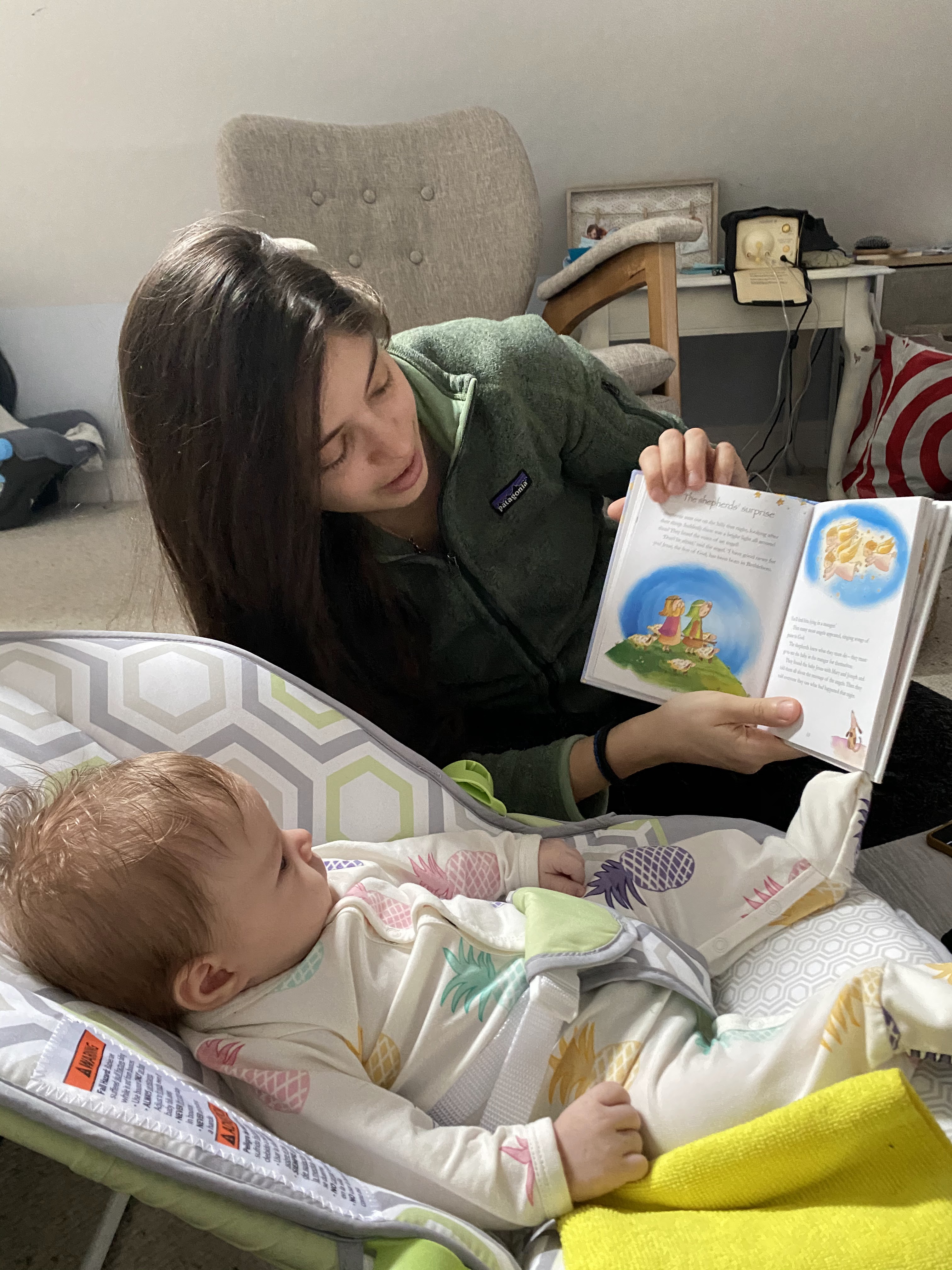
Before my daughter was born, my husband and I read to her. We'd pick a book from the small pile my mom, a retired school teacher and children's librarian, had sent us in the mail, giggling at the awkwardness of animatedly telling a story to my belly. We'd laugh at lines like, “Daddies are delicious,” and wonder what she'd think of these books once she arrived. 


Those early days feel long behind us now, but we never stopped reading to our daughter, now three, and our son, who just turned four months old. We've all gone through phases of waxing and waning interest and engagement, like our daughter at four weeks of age, when she'd stare at us with a puzzled expression—or just cry—or at one year when the most interesting thing about books was the flavor. From the sleepless nights of early infancy to the trying days of defiant toddlerhood, we have always come back to reading together. Whether cuddled on the couch on a rainy afternoon or plopping down in a corner of our local library, reading together has become a comforting constant for our family. 

Reading as a family is more than just a pleasant activity to enjoy together. Reading to children as young as newborns has many benefits both in their early brain development and further down the road once they are school-aged. Literacy has been associated with higher education completion rates and earning potential and lower school dropout and incarceration rates. Moreover, the vast majority of brain development occurs in the window from birth to two years of age. Reading to children during this critical period facilitates that development. 

The benefits of reading with young children are well studied, and as a pediatrician, I'm lucky to work with and counsel new parents throughout early childhood on why reading to children can be so beneficial. Here are just a few reasons why reading to your kids is so important—especially at a young age—and some tips on making it more fun as a family. 

Reading aloud improves early childhood vocabulary. Children learn words from what they hear in the world around them. Some of this comes from conversations with parents and peers. But books—even picture books—have richer, more complex language and expose children to higher-level vocabulary at an early age. Both types of language are crucial for success later in life, and the more words children are exposed to early in childhood, the more successful they are at reading once they reach school age. 

You certainly don’t have to start with long books containing big words or complex sentences; in fact, it’s best to start small. For young infants, choose picture-forward books with shorter text. Brains are programmed to enjoy looking at faces, so books featuring people and facial expressions are a good choice at this age. You can talk about things happening in the pictures, ask open-ended questions, and point out objects on the pages. 

Reading exposes infants to natural speech patterns. Have you heard of serve and return language? If not, you've certainly heard it. It's the natural way that people converse with each other every day, such as asking a question while another person replies or making a comment that someone responds to. It’s often described as a tennis match. One person serves the ball to their partner across the net, and the other returns it, continuing the conversation This type of interactive speech pattern has many benefits both in speech development and secure attachment to caregivers. Not only does it model and help babies practice this style of speech pattern, but also, by encouraging and responding to an infant’s coos and babbles, it fosters secure attachment and positive brain development. 

How can you practice serve and return language with your kids? Ask questions! What do you think will happen next? Who do you see in this picture? Will you count all the animals with me? Try it the next time you're reading with your child. Even in the pre-verbal period, this encourages infant babbling, which develops into normal language patterns later in life. 

Reading together promotes parental bonding. When you enjoy doing something, you want to do it more. Anyone who has binge-watched a TV show or eaten chocolate can tell you this, but it’s also a scientific fact. Reading is no different. When children associate reading with curling up on the couch with loved ones, it creates a positive association that will bring them back to reading again and again. 

Some great ways to incorporate more reading into quality time include reading during bedtime and naptime routines, taking little ones on outings to the library, and attending local story time events with them. We also always keep books within arm’s reach at home—we keep a large basket of picture books next to the couch, in our bedroom, and in our children’s play spaces. Some parents may use a tent, pillows, or toddler-sized furniture to create a reading nook in the home. This creates plenty of natural opportunities to plop down on the couch and read together. 

Reading the same story allows for language acquisition. Any parent of a toddler right now can probably recite every word of at least one of their kid’s favorite books. For us, it’s Little Blue Truck and Chicka Chicka Boom Boom. At their peak, my daughter would ask us to read these books upwards of ten times a day. What gives? As it turns out, it’s more than just your toddler trying to assert some autonomy (although that’s certainly part of it). Every time you reread that story, your child is listening, learning, and solidifying their understanding of new words and concepts. With each reread, children are listening, processing, and understanding more of what’s being read. 

Reading together is an important part of school readiness. In addition to exposing children to natural speech patterns and vocabulary, reading together introduces children to the building blocks of literacy. This includes identifying sounds in spoken words, connecting letters to sounds, understanding what is being read, vocabulary, and fluency. While your child doesn't have to be reading before kindergarten, exposure to the building blocks of literacy through reading aloud together will help children achieve literacy once they reach school age. 

A final note. Reading to a young child is not always easy. It may feel strange in early infancy or later, in the toddler years. It may become exhausting as they get distracted, uninterested, or feel too wiggly to sit through an entire book. The one constant in early childhood is that kids change constantly; what didn’t appeal to them last week will suddenly become their favorite thing. Remember, if your child goes through a period where they’re no longer interested in reading, don’t push it, and try not to sweat it. You can always switch to shorter books, less time reading, or take a break altogether and try again in a few days.

Not long ago, I came home from a shift stressed out. It had been a busy day, with back-to-back patients, complicated issues to triage, and little time to eat, drink, or pump breast milk for my baby boy. I walked through the door on edge and eager to shower off the stress and germs of a busy day at the clinic before hugging my little ones. 

“Mama, I missed you! Can we read?” My daughter, almost three here, was making a beeline to hug me, scrubs and all. 

“Not yet!” I said. “Wait until I’ve showered!” 

Since we’re heading into cold and flu season, I make a conscious effort to change clothes before embracing my children. A shock of guilt ran through me. The disappointment was written all over her face. 

I hurried through my shower and tossed on my favorite lounge pants, sweatshirt, and socks, eager to find my daughter before she lost interest in hanging out with me. I found her in one of our favorite reading spots, curled deep into the corner of our couch, surrounded by her stuffed animal friends, her favorite plastic Maui figurine, and, of course, piles of picture books. She was reading to herself—or at least trying. She’s memorized a few of her favorite titles by heart. 

“Sorry, I had to shower first,” I told her. “Can we still read some books together?” A smile lit up her face. “Of course we can!” she exclaimed. “Let’s start with this one.” 

Sources: 

1. Lee, Melissa. When it comes to salary, it’s academic. The Washington Post, July 1994. 

2. Rogot et. al. Life Expectancy by Employment Status, Income, and Education in the National Longitude Mortality Study. Public Health Reports July-August 1992 (107): 457-461. 

3. Pfefferbaum A, Mathalon DH, Sullivan EV, Rawles JM, Zipursky RB, Lim KO. A quantitative magnetic-resonance-imaging study of changes in brain morphology from infancy to late adulthood. Arch Neurol. 1994;51:874–887 

4. Massaro DW. Reading Aloud to Children: Benefits and Implications for Acquiring Literacy Before Schooling Begins. Am J Psychol. 2017 Spring;130(1):63-72. doi: 10.5406/amerjpsyc.130.1.0063. PMID: 29508957. 

5. Serve and return. Center on the Developing Child at Harvard University. (2020, January 27). https://developingchild.harvard.edu/science/key-concepts/serve-and-return/ 

6. Kok, R., Thijssen, S., Bakermans-Kranenburg, M. et al. (2015). Normal variation in early parental sensitivity predicts child structural brain development. Journal of the American Academy of Child and Adolescent Psychiatry, 54(10), 824–831.

7. Kuhl, P.K., Ramírez, R.R., Bosseler, A., Lin, J.L. & Imada, T. (2014). Infants’ brain responses to speech suggest analysis by synthesis. Proceedings of the National Academy of Sciences. 111(31) 11238-11245. 

8. Malenka RC, Nestler EJ, Hyman SE (2009). Sydor A, Brown RY (eds.). Molecular Neuropharmacology: A Foundation for Clinical Neuroscience (2nd ed.). New York: McGraw-Hill Medical. pp. 147–148, 367, 376. 

9. Razdan, S. (2023). 10 tips to help your child fall in love with reading. HealthyChildren.org. https://www.healthychildren.org/English/ages-stages/gradeschool/school/Pages/10-Tips-to-Hel p-Your-Child-Fall-in-Love-with-Reading.aspx#:~:text=Read%20together%20before%20bedtime.,r ead%20a%20book%20to%20you! 

10. Horst JS, Parsons KL, Bryan NM. Get the story straight: contextual repetition promotes word learning from storybooks. Front Psychol. 2011 Feb 17;2:17. doi: 10.3389/fpsyg.2011.00017. PMID: 21713179; PMCID: PMC3111254. 

11. burrows, heather. (2017). Reading and literacy in children | CS mott children’s hospital . Reading and Literacy in Children. 

https://www.mottchildren.org/posts/your-child/reading-and-literacy-children

How I Feel About Vaccines

Tuesday, November 5, 2019

girl covering her face with both hands
Photo by Caleb Woods via unsplash.com


When measles cases in Brooklyn and Rockland county shot  past the hundreds last spring,1 I began to realize the gravity of the situation at hand. In the hospital where I was working, we had already admitted several children with severe measles infections and a young boy with a superinfection of his chickenpox rash that required intravenous antibiotics. In our pediatric ICU, a strong, healthy high school track star was intubated and fighting for her life after contracting pneumonia following a severe bout of the flu. These children could have avoided significant pain and suffering had they been vaccinated. 

I wish vaccine-hesitant parents could see what I see. Measles, flu, even varicella- these diseases can cause tremendous suffering, and even death. In 2019 more people in the Democratic Republic of Congo died of measles than of Ebola.2 In the U.S. the 2017-2018 flu season left an estimated 80,000 people dead.3 186 of those were children.

When I reassure vaccine-hesitant parents that there is incredibly strong evidence that vaccines are safe and effective, and that the study suggesting an association between vaccines and autism has long since been debunked,5 it doesn’t seem to work. It’s a matter of choice, they tell me. Of their individual right as a parent. But the problem is that this is a choice that affects the health and safety of other people, too.

Viewing vaccine choice as an individual right and issue does not take into consideration the dual purpose of vaccines. Yes, vaccines will prevent an individual from becoming ill. But they also have another crucial effect: herd immunity.6 When at least 90%-95% of a population is vaccinated (the number varies slightly by vaccine,) the illness becomes less common and everyone is protected,7 including those who cannot be vaccinated because of their age or health. They can go to school, to parks, or to other public places with little worry of becoming ill, because the herd of vaccinated neighbors, schoolmates and cohabitants protect them. What should these children do now that vaccination rates in some communities hover as low as 50%? Measles is so aggressively contagious that we shut down our entire urgent care clinic for cleaning when a patient was diagnosed. For children who are to sick or too young to get the MMR vaccine, even walking into your doctor’s office during an outbreak becomes unsafe.  

person injecting someone on his arm
Photo by Hyttalo Souza via unsplash.com 

To be fair, the medical community shoulders some responsibility for vaccine refusal and hesitancy in the United States. In the age of endless information, perhaps it’s been too easy for us to be dismissive of parental concerns and hesitation, without delving deeper into where these concerns are coming from. Some communities have genuine reason to view the medical community with doubt and suspicion, given the Tuskegee syphilis experiment,8 or the coerced sterilization of some minority women.9 Perhaps we have been too quick to tell parents to stop googling, when we should have been having open conversations about why families seek out alternative, questionable sources for information in the first place.

Shortly after the outbreak was declared I was back on the wards. The child with chickenpox had lost his IV, and I was asked to help replace it using an ultrasound machine, since his severe rash was making the task difficult. Even before I entered the room, I could hear him crying. He had been miserable for days with significant itching and pain. As I prepared to place the intravenous line in what was probably a third or fourth attempt that day, a strange thought popped into my head. I wondered if this little boy was given the option of getting vaccinated or being subjected to this, what would he have chosen? 


Note: certain details in this story have been changed to maintain patient privacy. All of the cases discussed are real. All words, thoughts and opinions are my own. 

References
1.     Goldschmidt, D. (2019, May 13). More than 800 cases of measles in US, with NY outbreak continuing to lead. CNN. Retrieved from https://www.cnn.com/2019/05/13/health/measles-update-cdc-800-cases/index.html
2.    Rossman, J., & Badham, M. (2019, September 18). Over 3,000 people have been killed by a deadly virus in DR Congo this year —and it’s not Ebola. Quartz Africa. Retrieved from https://qz.com/africa/1711485/measles-is-killing-more-people-in-dr-congo-than-ebola/
3.  Center for Disease Control. (2018). Estimated Influenza Illnesses, Medical visits, Hospitalizations, and Deaths in the United States — 2017–2018 influenza season. Estimated Influenza Illnesses, Medical visits, Hospitalizations, and Deaths in the United States — 2017–2018 influenza season. Retrieved from https://www.cdc.gov/flu/about/burden/2017-2018.htm
4.  Vaccine Safety: The Facts. (2018, October 10). Retrieved October 23, 2019, from https://www.healthychildren.org/English/safety-prevention/immunizations/Pages/Vaccine-Safety-The-Facts.aspx.
5.   Eggertson, L. (2010). Lancet retracts 12-year-old article linking autism to MMR vaccines. Canadian Medical Association Journal, 182(4), E199–E200. doi: 10.1503/cmaj.109-3179
6.     Boyd, R. (2016, April 18). It Takes a Herd. Retrieved October 23, 2019, from https://www.aap.org/en-us/aap-voices/Pages/It-Takes-a-Herd.aspx.
7.  Funk, S. (2017). Critical immunity thresholds for measles elimination. Critical immunity thresholds for measles elimination. London School of Hygiene and Tropical Medicine. Retrieved from https://www.who.int/immunization/sage/meetings/2017/october/2._target_immunity_levels_FUNK.pdf
8.  Brown, D. N. (2017, May 16). ‘You’ve got bad blood’: The horror of the Tuskegee syphilis experiment. The Washington Post.
9.    Ko, L. (2016, January 29). Unwanted Sterilization and Eugenics Programs in the United States. Retrieved October 23, 2019, from http://www.pbs.org/independentlens/blog/unwanted-sterilization-and-eugenics-programs-in-the-united-states/